
| U.S. States and U.S. Territories | Anywhere Else in the World |
|---|---|
|
|
|
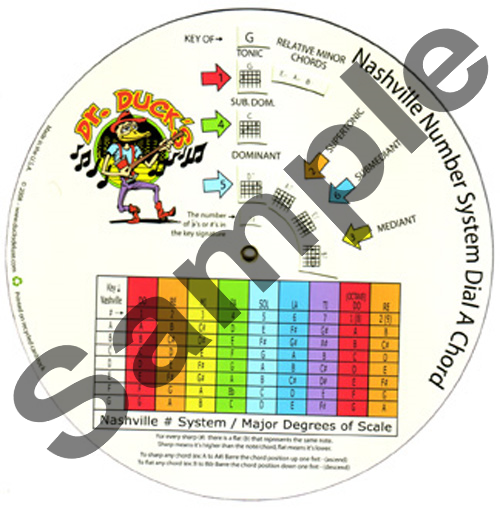
Also on the front is the "Color-CODED Quick Check Reference Grid" of the Nashville Number System which goes up to "The 9"... (the 1 is red, the 2 is orange, the 3 is yellow, the 4 is green, etc.)...
On the back ... a full explanation of the "Nashville # System" along with how to make the minor guitar chords and shows the "Natural Qualities" of the chords (major or minor).
It also shows you how many sharps or flats are in each key signature, the names of the diatonic scale degrees (tonic, dominant, mediant, etc.), the Solfa names of the scale positions (the do, re, mi's,)
No music reading is necessary to use "The Nashville Number System Dial A Chord"
GREAT ! ... for all those who do not have time for a regular diet of guitar lessons as well as the graduates from the "guitar video games" who want to start playing guitar ... and anyone else who wants an instant reference on how to make every guitar chord in all 12 keys at the first position and a Color-CODED quick reference and a detailed explanation of the Nashville Number System.
So ... if you're ever unsure which chords sound best with each other in the key of "Eb" ... just dial up "Eb" and the "Nashville Number System Dial A Chord" will show you which chords go with the key of "Eb", the diagrams show you how to make those chords and which numbers in the Nashville # System the chords are called - (the 1, 2, 4, 5 etc.).
* 8" in diameter printed in full Color on 16 point recycled card stock and UV plastic coated. - bar coded for retail scanners - Made in the USA -
* Dealers - they come with a POP counter display.
Welcome to the ultimate resource to learn or review the aspects of the Nashville Number System and to learn how to make every guitar chord in every key ... what "Dr.Ducks Nashville Number System Dial A Chord" covers can impact the rest of your musical life ... no matter your skill level or musical style ... Enjoy ...
| U.S. States and U.S. Territories | Anywhere Else in the World |
|---|---|
|
|
|

 The Nashville Number System Explained In Detail ..
The Nashville Number System is a shorthand method of writing musical arrangements that was developed by Nashville studio musicians based on the degrees of the scale (do, re, mi, fa, sol, la, ti ..). It is a powerful tool in the written communication of music.
This system uses Roman Numerals ( I, II, III etc. ) or Arabic Numbers (1, 2, 3 etc..) instead of chord letters. This is because folks do not always play the same song in the same key. Also, some will use a capo, while others will not. This system prevents the musician from having to rewrite chord charts to reflect their own key preference.
All numbers are relative to the key you decide to play it in. For example, the "3rd" in a C chord is an E note; using the root (C) as the number one, and counting upwards ie. C = 1, D = 2, and E = 3, etc. The chart below will help you understand it better and help you to figure out the chords if you need help.

With the Nashville Numbering System, we can then base these Roman Numeral / Arabic Numbers by Key to find what they are.
The numbers are the notes in the scale in order. For example, in C we have:
C - D - E - F - G - A - B - C
1 - 2 - 3 - 4 - 5 - 6 - 7 - 1
So a 1-6-2-5-1 Progression in the "Key of C" is:
C-Am-Dm-G7-C
Or even adding Extensions:
CM7-Am9-Dm9-G13-CM7....etc.
Just to go over some basics.
The first key point is the "qualities" of the numbers.
In a major key the "natural qualities" of the chords are:
1 - Major
2 - Minor
3 - Minor
4 - Major
5 - Major
6 - Minor
7 - Minor Diminished
You can see how this works if you have access to a piano. Using only the white keys ( the key of C ), start with a C Major triad with C-E-G. Using the same fingering, just move the chord up 1 white key at a time and you'll hear the minor/major, etc..
The next key point is that you can "alter" chords. The 2 is naturally minor. But we can make it major by writing 2M or IIM, or 2Ma IIMa, etc.. There is not exact standardization of the way the chords are written in the number system. They can be in Roman Numerals ( I, II, III etc. ) or Arabic Numbers (1, 2, 3 etc..)
If a chord is written without in alteration, it is assumed to be the "natural" quality. So if you see this progression:
1 - 2 - 3 - 6
In C, that will be
C Major - D Minor - E minor - A minor
If you see
1 - 2M - 3M - 6
In C that would be C Major D Major E Major A minor
The next thing you should know is that you use parenthesis to indicate more than 1 chord per bar. For example, a progression with 2 chords per bar would look like this:
( 1 6 ) ( 2 5 ) ( 4Maj7 3mi7 ) ( 2X9 5X )
Now, I through some new stuff at you besides the parenthesis. The 4Maj7 indicates an FMaj7 chord in the key of C. The Maj7 indicates you want the 4 part 7th chord not just the F Major triad.
The 2X9, indicated a dominant 9th chord. The "X" is used to indicate a Dominant 7th type chord, like G7 in the key of C. The 9th indicated you want the Dominant 9th, not just the 7th.
Again, there are no exact rules for the way the chords are written. For example, some people like to use 4M7 for the 4 major 7th chord. Others will use 4Maj7.
By the way, the "natural" qualities of the 7th chords ( 4 note chords ), are:
1Maj7 - 2min7 - 3min7 - 4Maj7 - 5Dom7 - 6min7 - Bhalfdim
You will also find poly chord notation used. If you want to use the common 5 chord over the 1 chord you will see something like this:
1 5/1 4/1 5/1
The "/" is used to indicate a different bass note from the root of the chord. A few common non-root bass notes are:
1 1/3 4 4/6
5 5/7 1 5
Think of it as a "mental capo" ... you can learn to associate the SOUND of a chord or a progression with a number, or series of numbers. So even if you don't know what key a song is in, if you hear a C Ami F G progression, you know it is a 1 6 4 5 progression. You know the SOUND of that progression.
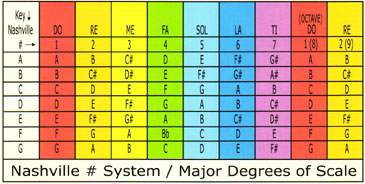
Reducing a chord chart to a numerical expression, is nothing new. "Figured bass" was used in Bach's time, and the solfeggio method, (the do, re, mi's,) of Italian musical pedagogy performed a function similar to the number system. What these approaches share is the naming of scale degrees. Do, Re, Mi; one, two, three; tonic, supertonic, mediant; and l, ll, lll all name the degrees of the diatonic scale.
By the way ... now that you know that the "2" in the key of "G" is "A" and you are starting on the "5" ( "D" ) to the "4" ( "C" )... a standard 12 bar progression is something like "Johnny B. Goode", 'StatesBoro Blues", "One Way Out", "Crossroads", "Folsom Prison Blues", etc...
Dr.Duck wants to thank Eric, Mike, Charles , the guys who created the first color chart (black background) and all the other web sites that were plagiarized ... line at a time (isn't copy & paste grand ..) to enable the staff of Ducks Deluxe to sort out all the info and present you with this (mostly) complete version of how to understand the Nashville # System ... In turn, in the interest of furthering the art of music globally, feel free to rip off as much of this as you want for any reason (your own web site / use in the band, choir, or...) ... You're Welcome ... Enjoy... Ever Onward ... Dr.Duck